



SIOLib
C Language Async I/O
SIOLib C Language Asynchronous I/O Core Framework
Designed for high-concurrency network communication, real-time data processing, long-connection services, gateway proxy, message distribution, and low-level service governance, SIOLib builds high-performance asynchronous I/O capabilities with C language, providing stable, efficient, and low-latency communication support for enterprise systems.
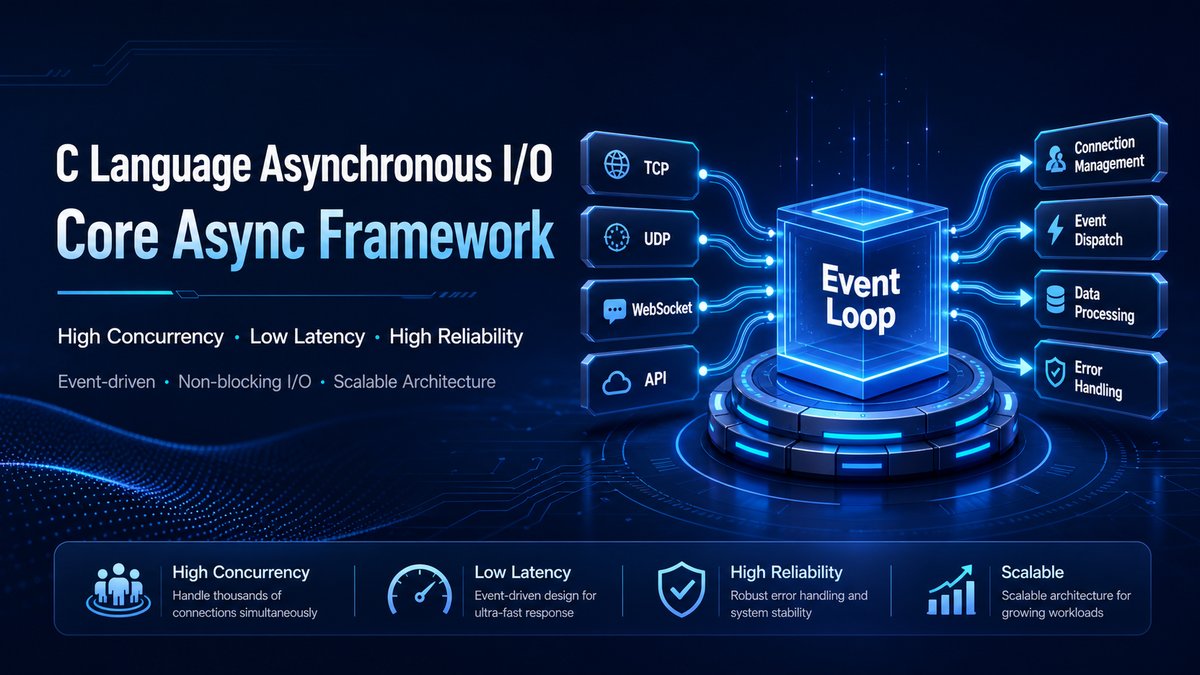
High-Performance Asynchronous Communication Capability
SIOLib C Language Asynchronous I/O Core Framework is suitable for server-side systems that require high-concurrency connections, high-speed data transmission, and continuous stable operation. Through an event-driven model, non-blocking I/O, asynchronous task scheduling, and connection lifecycle management, SIOLib brings massive network connections into an efficient event-processing workflow.
Compared with traditional synchronous blocking processing models, SIOLib can manage a large number of connection requests with fewer thread resources, reducing thread waiting, lowering context-switching overhead, and improving overall server throughput.
In scenarios such as high-concurrency API services, real-time message pushing, proxy forwarding, IoT device access, and edge node communication, SIOLib provides more stable, efficient, and scalable low-level communication capabilities.
SIOLib Core Operating Mechanism
SIOLib receives connections and data requests through non-blocking I/O, then uses the event loop to monitor, dispatch, and trigger business processing workflows, ultimately completing protocol parsing, task scheduling, data response, and message delivery.
Client Connection
Unified access for browsers, apps, devices, and server-side requests
Non-blocking I/O
Manages Socket connections, read/write events, and connection states
Event Loop
Monitors events, dispatches tasks, and triggers processing workflows
Protocol Parsing
Supports TCP, UDP, WebSocket, and custom protocol extensions
Task Scheduling
Handles business logic, callbacks, task queues, and message distribution
Response Output
Completes data responses, message push, connection reuse, and state synchronization
When a client connection enters the system, SIOLib receives the connection and data request in a non-blocking manner, then passes readable, writable, exception, and timeout events to the event loop. The event loop triggers corresponding business logic, protocol parsing, and asynchronous task scheduling according to different event types, allowing the system to maintain stable and efficient processing under high concurrency.
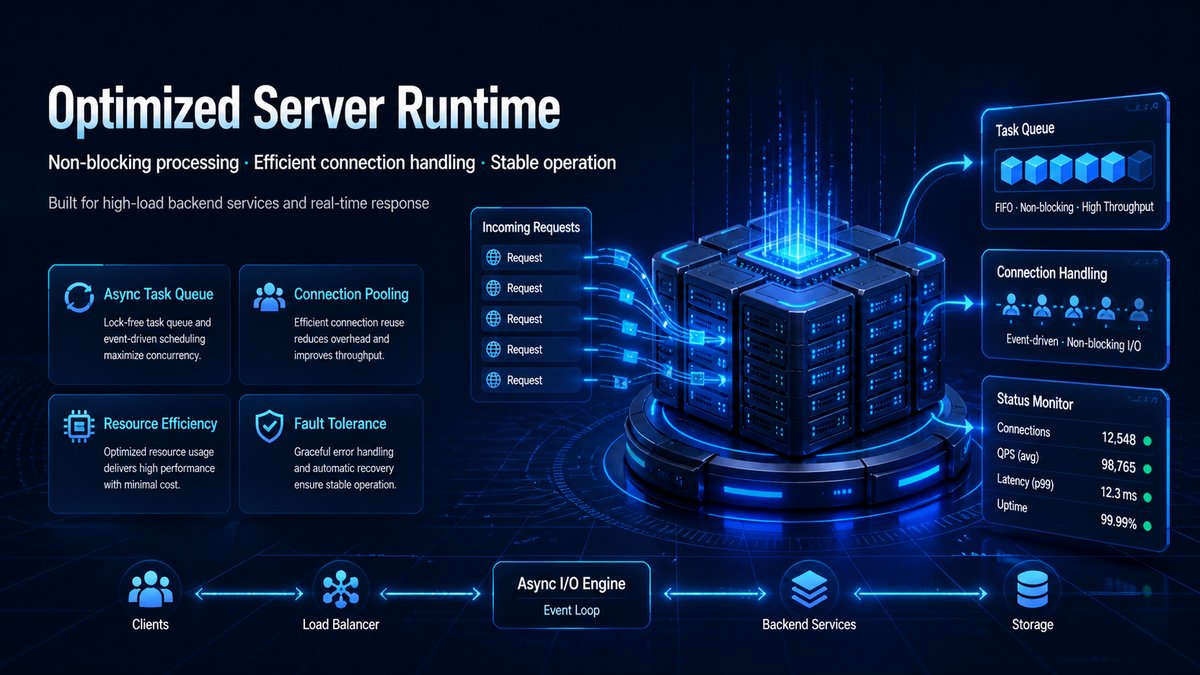
More Efficient Connection and Task Processing
During actual operation, SIOLib first receives network connection requests from clients, devices, or other services. After a connection is established, the system does not create a separate blocking thread for each connection. Instead, it registers the connection into the event listening mechanism.
When a connection generates read, write, close, or exception events, the event loop actively triggers the corresponding processing logic. After receiving the event, the business module can parse data according to the protocol type and pass complex tasks to the asynchronous task scheduling module.
After processing is completed, the system returns the result to the client through non-blocking writing. This process reduces thread waiting and resource waste, allowing the system to maintain fast response under high-concurrency environments.
SIOLib Core Capabilities
High-Concurrency Connection Management
Supports unified management of massive client connections and processes network read/write requests through asynchronous events, making it suitable for high-concurrency access and long-connection scenarios.
Non-blocking I/O Processing
Connections and data read/write operations do not occupy thread resources for a long time. Processing logic is triggered only when network events are ready, improving overall throughput.
Event-Driven Architecture
Uniformly monitors connection events, read/write events, timer events, and internal task events, making business modules clearer in decoupling and more flexible in expansion.
Asynchronous Task Scheduling
Supports asynchronous processing of time-consuming business tasks, message distribution, data processing, log writing, and state synchronization, reducing blocking in the main workflow.
Connection Lifecycle Management
Covers the full process of connection creation, authentication, data receiving, protocol parsing, abnormal disconnection, timeout detection, and resource release.
Low-Latency Data Processing
By reducing thread blocking, lowering context-switching overhead, and optimizing event scheduling, SIOLib maintains faster responses under high concurrency.
Technical Features
C Language Core Implementation
Reduces runtime overhead and improves low-level execution efficiency, making it suitable for high-performance server programs and communication services.
Event-Driven Model
Uses the event loop to uniformly process network events, task events, and timer events, improving system processing efficiency.
Non-blocking Communication Mechanism
Reduces thread blocking and improves server resource utilization, allowing more requests to be handled under the same hardware resources.
Modular Structure Design
Makes it easier to extend protocol parsing, task queues, connection management, message distribution, and business processing modules.
Stable Operation Capability
Supports exception handling, resource release, connection detection, timeout management, and continuous service operation.
Multi-Scenario Adaptation
Can be used for gateway services, proxy services, device access, messaging systems, and real-time data forwarding.
Applicable Business Scenarios
SIOLib is suitable for server-side systems with high requirements for performance, stability, and real-time response, especially for scenarios that require handling massive connections, high request volumes, or continuous data transmission.
- High-concurrency API services
- TCP / UDP network communication services
- WebSocket long-connection services
- IoT device access platforms
- Proxy gateway and data forwarding services
- Message push and real-time notification systems
- Real-time log collection and transmission systems
- Edge computing node communication services
- High-performance internal service communication components
- High-throughput, low-latency low-level service systems
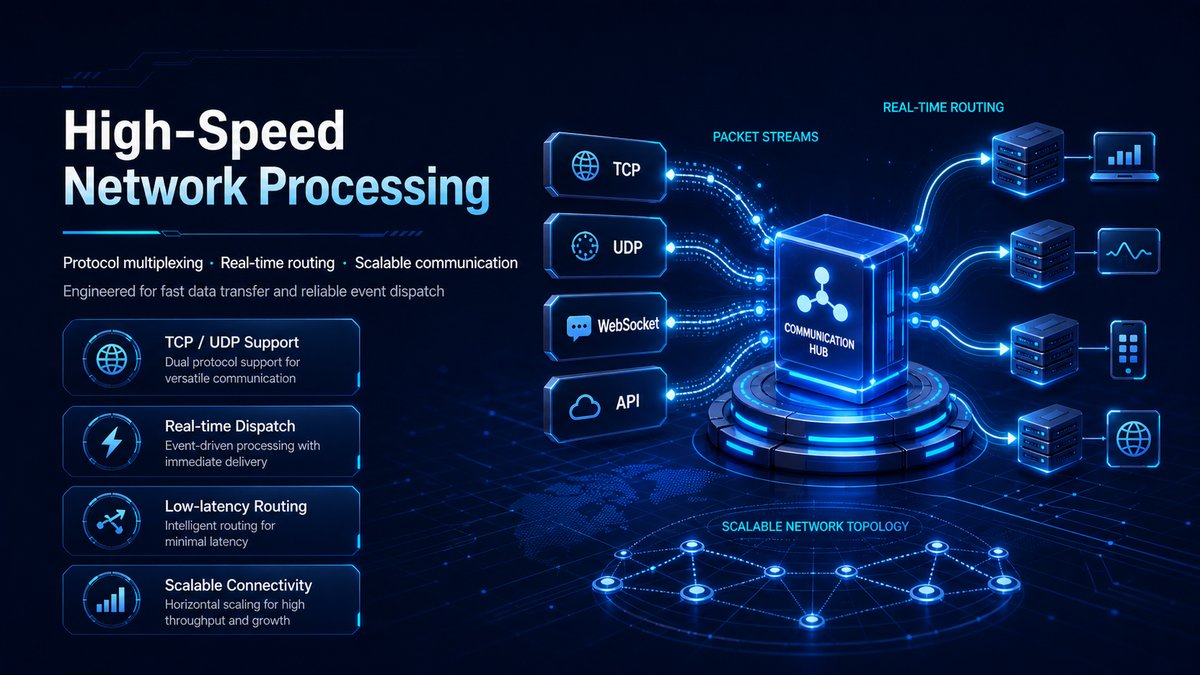
Business Value for Enterprises
Improved Service Performance
Enhances concurrent processing capability and keeps business systems responsive under high traffic.
Lower Resource Consumption
Reduces blocking threads and ineffective waiting, improving CPU, memory, and connection resource utilization.
Stronger Scalability
Supports flexible extension of protocols, tasks, connections, messages, and business modules.
Stable Operation Assurance
Designed for long-running scenarios, enhancing exception handling, connection detection, and resource recovery capabilities.
SIOLib makes high-concurrency communication more efficient, stable, and scalable
Built with C language, SIOLib provides high-performance asynchronous I/O capabilities to support enterprise network communication, real-time data processing, and core service operations.